OUT TODAY: Our COP31 Policy Brief
Wednesday 28 October 2026
“We reject a future in which the Pacific is remembered for what the world allowed to disappear. We claim instead a future shaped by ourselves, not as passive victims of climate change, but as active agents of justice, custodians of our lands and ocean, and leaders of the transformation the world urgently needs.”
— The Funafuti Call for Climate Justice
For months, the Climate and Health Alliance (CAHA) and the Alliance for Future Generations Fiji (AFG Fiji) have been collaborating on an ambitious work program Voices of the Vanua to centre Pacific voices and priorities at COP31.
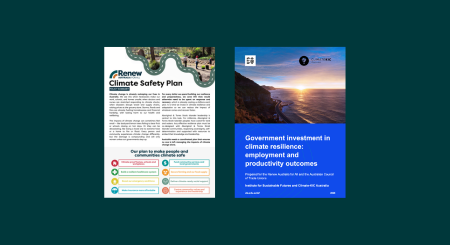
After a long journey of collaboration, we are excited to make public the Voices of the Vanua COP31 policy brief.
This brief sets out policy priorities which uphold Pacific peoples’ legal rights to health, safety and culture. It aims to inform policy, financing and implementation decisions that deliver existing commitments, address gaps identified through evidence and lived experience, and strengthen accountability for results.
Read it here

Many months of collaboration have gone into the policy brief
CAHA and AFG Fiji has undertaken a rigorous process of evidence collection and generation to genuinely elevate Pacific voices and priorities before, during, and after COP31.
Synthesis of evidence
We undertook a review of academic literature, focusing on:
-
climate-related health impacts in the Pacific;
-
health equity implications of mitigation and adaptation policies;
-
women’s reproductive, sexual and maternal health, and youth health;
-
health service resilience and mitigation; supply chains; and service access;
-
Indigenous leadership and Pacific lived experience.
We undertook a targeted review of relevant policy documents to situate the project within existing Pacific priorities and commitments:
-
First, regional frameworks, strategies and declarations addressing climate change, resilient development, climate mobility and financing, to establish shared principles and priorities for the region;
-
Second, national policies, including Nationally Determined Contributions, national adaptation plans, and health adaptation plans, to see priorities reflected in national commitments;
-
Third, relevant regional and national sectoral policies beyond climate change and disaster management;
-
Fourth, relevant international frameworks and technical guidance as supplementary reference points to explore remaining gaps.
We collected eight case studies from the region via Zoom or via interviews at the Pacific Islands Health Resilience Forum in early September (six from Fiji, one from Hawai’i and one from a Pacific woman working in QLD, Australia). These case studies provide local examples of how climate change is affecting health systems and communities, and of the practical challenges and opportunities for culturally appropriate responses. Case studies primarily focused on health infrastructure (health system resilience, local workforce capacity, disaster risk reduction), mental health (displacement and culturally appropriate care), and women’s health (reproductive health). Public summaries will be made available with consent.
The findings of our evidence review can be seen in our Evidence Synthesis report and our Frontline Realities report.
Review of Pacific Civil Society Organisational Statements
We considered statements from Pacific civil society organisations (CSOs), who have developed regional priorities on climate change for decades through thousands of consultations and meetings. Consultative processes and talanoa are internationally recognised research methods which are culturally appropriate in the Pacific region.
Salt Water in our Blood: Pacific Climate and Health Talanoa in Nadi, Fiji
The cornerstone of the evidence gathering was the Pacific Climate and Health Talanoa. A Talanoa is a traditional Pacific Island open dialogue concept without hierarchy or a strict agenda. This method is a trusted method for co-creating evidence, sharing perspectives, and developing collective understanding.
We supported a Pacific-led Talanoa on 8 October in Narewa Village, Nadi, Fiji. People gathered at the Methodist Church Hall of Narewa from Kiribati, Fiji, Tuvalu, Hawaii, Jamaica and the Torres Strait Islands. The demands align with the academic literature, case studies and Pacific CSO statements, and can be seen in our Talanoa Outcomes communique.
CAHA Leaders Summit
56 health leaders from the CAHA membership gathered in Canberra to hear the stories and priorities coming from the Pacific, and were asked to stand behind Pacific communities in their calls for climate justice and health equity. Out of the summit came the Leaders Summit Statement.
Thank you to the hundreds of people who have contributed to this work program to this point. Now onwards ... to COP31.
Thank you to the Wellcome Trust for making this work possible.